
The filing of offer documents with the capital markets regulator - Securities and Exchange Board of India - has more than halved this financial year (2022-23, or FY23) as the outlook for new share sales has worsened, following correction in the secondary market. So far in FY23, 66 companies filed their draft red herring prospectus (DRHP), as opposed to 144 in the preceding financial year (2021-22, or FY22).

A figure above 50 indicates that the sector is expanding, while a figure below that level means contraction.

IndusInd Bank was the top gainer in the Sensex pack, soaring over 7 per cent, followed by Bharti Airtel, HCL Tech, Tata Steel, Tech Mahindra and Dr Reddy's.

In twin blows to Indian economic revival, higher food prices drove retail inflation to a five-month high of 7.4 per cent while factory output fell for the first time in 18 months. The second consecutive month of rise in consumer price index (CPI)-based inflation will add to the pressure on the Reserve Bank of India (RBI) to again raise interest rates to tame high prices. Inflation has been above the targeted zone for the ninth month in a row and as per statute, the RBI will now have to explain to the government in writing why it failed to keep prices below 6 per cent.

Omkeshwar Singh, Head, Rank MF, a mutual fund investment platform, answers your queries.

New Delhi slipped by two positions to rank 39th globally in terms of price appreciation of prime residential properties during the September quarter, according to Knight Frank. Mumbai ranked 40th, same as the June quarter, while Bengaluru moved up one spot to 42nd rank. New Delhi stood at the 37th rank, while Mumbai and Bengaluru were at 40th and 43rd positions, respectively, during the second quarter of 2021 calendar year. In its 'Prime Global Cities Index Q3 2021' report, Knight Frank tracked the movement in prime residential prices in local currency across 45-plus cities worldwide.

The headline for corporate profit growth has been very encouraging in the July-September quarter (Q2) of 2023-24 (FY24), with the combined net profit of listed companies up by 38 per cent year-on-year. However, the earnings distribution has been very lopsided, with most of the growth coming from public-sector oil-marketing companies (OMCs), banks, non-bank lenders, automobile (auto) companies, and cement producers. By comparison, companies from information technology services, fast-moving consumer goods (FMCG), retail, and consumer durables were disappointed, experiencing a sharp slowdown in net sales growth and a relatively muted increase in reported net profit.

A reading below 50 means contraction in the sector.

Retail inflation declined to an 18-month low of 4.7 per cent in April mainly due to falling prices of vegetables, oils and fats, and came closer to Reserve Bank's target of 4 per cent, showed government data released Friday. It was for the second month in a row that Consumer Price Index (CPI) based inflation remained within the RBI's comfort zone of below 6 per cent. The government has tasked the central bank to ensure retail inflation remains at 4 per cent with a margin of 2 per cent on either side.

On the employment front, services employment was unchanged in April.

Omkeshwar Singh, Head, Rank MF, a mutual fund investment platform, answers your queries.

The RBI left interest rates unchanged, saying there was no substantial development on inflation or fiscal fronts to warrant a fresh reduction.

Delhiites woke up on Thursday to a thick envelope of smog as air quality in the national capital and in adjoining regions, dipped into severe category again.

Technology firm Wipro has a "high probability" of getting included in the benchmark Sensex, while two-wheeler major Bajaj Auto is the "most likely" deletion candidate, according to an analysis done by Brian Freitas, an analyst at independent research provider Smartkarma. The changes to the index will be announced mid-November, and will become effective from December 17. The December review uses the 6-month average market capitalisation and trading turnover data between May 1 and October 31 to determine changes.

'The long maturity of these funds makes them well-suited for long-term financial goals such as saving for retirement or children's education or marriage.'

The HSBC Manufacturing Purchasing Managers' Index, compiled by Markit, fell to 52.4 in August from 53.0 in July but chalked up its tenth month above the 50 mark that divides growth from contraction.

IndusInd Bank was the top gainer in the Sensex pack, rising nearly 6 per cent, followed by Axis Bank, SBI, Maruti, Tech Mahindra and Reliance Industries. NSE Nifty surged 183.70 points to close at 17,166.90.

The clarification by the National Securities Depository (NSDL) - which is tasked with monitoring foreign portfolio investor (FPI) investment in domestic stocks - that the accounts of top investors in Adani group stocks remain 'active' has helped prevent a $500-million selloff of shares. Analysts said a freeze of the FPI accounts, as reported by some media outlets, could have prompted global index providers to cut weighting of four Adani group companies from their global indices. Brian Freitas, an analyst at independent research provider Smartkarma, said if the FPI accounts were indeed frozen, FTSE and MSCI would have reduced weighting of Adani group companies at the next rebalance, since it would have meant that the large part of the free float was not tradeable.

India's manufacturing sector activity moderated in January amid slower increase in total sales, and headcounts were broadly unchanged amid sufficient staff numbers to cope with current requirements, according to a monthly survey. The seasonally adjusted S&P Global India Manufacturing Purchasing Managers' Index (PMI) fell from December's recent high of 57.8 to 55.4 in January, as factory orders and production rose at sharp, albeit slower, rate. The January PMI data pointed to an improvement in overall operating conditions for the 19th straight month.

Private sector output in India expanded for the first time in 8 months in February as slump in the services sector moderated and manufacturing grew at a stronger pace, an HSBC survey said.

'Pollution acts as an endocrine disruptor.' 'When it acts as an endocrine disruptor it has an effect on the endocrine system of the human body and the effect on the pancreas is an important one.' 'The way you get type two diabetes is due to two defects.' 'One is the pancreas doesn't produce enough insulin.' 'The other physiological defect is insulin resistance.'
The index went below the crucial 50 mark.

A new law that defines how companies should process users' data came into force with the President giving assent to the Digital Personal Data Protection (DPDP) Act passed by Parliament in the just-concluded monsoon session. The law arms individuals with greater control over their data while allowing companies to transfer users' data abroad for processing, except to nations and territories restricted by the Centre through notification. It also gives the government power to seek information from firms and issue directions to block content.

Consumer stocks remain the biggest laggard on the bourses. The Nify50 weighting of FMCG stocks declined to a decade low of 9.9 per cent at the end of March this year, down 150 basis points from 11.4 per cent a year ago. At their peak in March 2013, major FMCG stocks, such as Hindustan Unilever, ITC, and Asian Paints, together accounted for 15 per cent of the Nifty50. But now together with automobile stocks, the consumer goods sector accounts for only 14.7 per cent of the index, down 200 basis points in the past 12 months and 37 per cent from the record high weighting of 23.4 per cent at the end of March 2014.

New business orders fall at faster pace, with index at 47.6 in March from 49.5 in February.
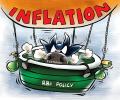
The Reserve Bank on Wednesday projected inflation to come down below the upper threshold level of 6 per cent by March quarter of the current fiscal. RBI Governor Shaktikanta Das said the central bank will keep 'Arjuna's eye' (focus) on the evolving inflation dynamics and will remain 'nimble and flexible' to deal with the price situation. Global commodity prices, including crude oil, have undergone some downward correction, but uncertainty continues to surround the near-term outlook in view of the prolonging geo-political hostilities. Moreover, the resurgence in domestic services sector activity could also lead to price increases, especially as firms pass on input costs.

Titan was the top gainer in the Sensex pack, zooming over 10 per cent, followed by M&M, Maruti, IndusInd Bank, Asian Paints, Sun Pharma, HCL, TCS, Tech Mahindra and ICICI Bank. The NSE Nifty rose 144 points to 17,790.35.

Mutual funds have ratcheted up Rs 53,700 crore (Rs 537 billion) through new fund offers (NFOs) in 2022 until November, against Rs 1 trillion in Calendar 2021, notwithstanding the number of launches this year eclipsing the 2021 tally. Industry insiders cite the absence of launches in popular categories as the reason behind lower collections this year. Typically, only NFOs in popular categories from major fund houses rake in the moolah.

The reopening of China has led to an ongoing readjustment of the global metals and commodities markets. China has a massive production capacity surplus to its own domestic demand. At the same time, it also has high domestic demand. China is also becoming carbon sensitive.

S&P Global Ratings on Tuesday kept India's economic growth forecast in the fiscal year to March 2022 unchanged at 9.5 per cent but raised its predictions for the subsequent year on broadening out of the recovery. The Indian economy had shrunk by 7.3 per cent in 2020-21 fiscal (April 2020 to March 2021) as pandemic induced restrictions battered business activity. The gradual lifting of the restrictions has helped the economy to rebound from pandemic lows.

Avoid discontinuing your SIPs. Persist for at least 7-10 years.

The central air quality panel had on Friday allowed authorities in Delhi-NCR to resume physical classes for students in classes 6 and above, colleges and other educational institutions with immediate effect.

I stumbled upon shares worth around Rs 300,000 in my late father's name, which are currently with the Investor Education & Protection Fund, points out Harsh Roongta.

Hiring activity in the country touched an all-time high in July, witnessing a 11 per cent sequential increase, indicating a strong revival of economic growth and a recovery of business from the impact of COVID-19, a report said on Friday. With 2,625 job postings, hiring trends grew 11 per cent in July compared with 2,359 postings in June, the highest it has ever been, including the pre-COVID-19 timeline, according to the report by Naukri JobSpeak. The Indian job market has witnessed sequential growth for the second month in a row, with a 15 per cent rise in June, after the pandemic-linked decline in April and May, it stated.

'It's important that every portfolio is well diversified.' 'My own portfolio is diversified across asset classes: 50% is in equity funds, 15% in international schemes, 25% in debt funds and 10% in sovereign gold bonds.'

Exactly a fortnight ahead of the Reserve Bank of India's (RBI's) next monetary policy review, a key market indicator of interest rates - the overnight indexed swap (OIS) - suggests that the central bank may tighten policy by 35 basis points and then refrain from further rate hikes. RBI Deputy Governor Michael Patra recently described the OIS as the primary instrument for hedging interest rate risk in India. The six-member Monetary Policy Committee (MPC) of the RBI will meet on December 5-7.
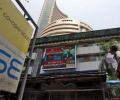
The BSE's arm Asia Index has announced Wipro will replace Bajaj Auto in the 30-share Sensex. The move is part of a semi-annual rebalancing exercise and will take effect when the market opens for trading on December 20. On account of the rejig, Wipro will see buying by passive funds to the tune of Rs1,300 crore, while Bajaj Auto will see selling of Rs 636 crore, estimate analysts.

Delhi Chief Minister Arvind Kejriwal announced that primary schools will be closed from Saturday in view of spike in pollution levels in the national capital.

Syed Abdul Mueed is the third son of the Hizb chief to have been sacked from the government job.

Inflation data, both at domestic and global level, interest rate scenario in the US, geopolitical situation and general elections in 2024 are some of the major factors that would influence trading in the equity market this financial year, analysts said. Besides, foreign fund trading activity and global trends will also dictate terms in the equity market going ahead. Equity markets across the globe faced major challenges in FY23 due to concerns over high inflation, which resulted in increase in interest rates around the world, lowering investor sentiment, experts added.
 © 2026 Rediff.com - Advertise with us - Disclaimer - Privacy Policy - Sitemap - Feedback - About us - Terms of use - Grievances